Blog

  • The Cool Roof Revolution: How Cities Are Rediscovering Indigenous Methods to Combat Heat

    Step outside in most cities today and you’ll feel it, a kind of heat that clings to buildings, radiates from pavements, and turns your own home into an oven by noon. Urban summer is no longer just inconvenient, many would say it is unbearable. In many places, it’s becoming a structural problem, one that architecture and infrastructure were never designed to handle.


    As temperatures rise, cities have been looking for solutions. Air conditioning helps, but only if you can afford it, power it, and keep the grid from collapsing. So planners and governments are being forced to ask a quieter question, what if the problem isn’t that we lack technology, but that we forgot how to build for heat in the first place?


    That question has led many of them back to the roof.



    A view of buildings in Yazd, Iran | Image Credit: Dad hotel on Unsplash


    In New York City, more than a million square feet of rooftops have been coated with reflective paint in recent years. The idea is simple. Lighter surfaces absorb less heat, which keeps buildings cooler and reduces the need for energy-intensive air conditioning. For residents without reliable cooling, that difference can be the line between discomfort and danger.


    But what’s most striking is how old this idea is.


    Long before “cool roofs” entered climate policy documents, communities living with extreme heat had already figured out how to manage it. In parts of Rajasthan, lime-coated roofs reflected sunlight and kept homes habitable through brutal summers. Across the Mediterranean, whitewashed buildings served the same function. These choices were practical responses to climate that later  came to be recognised as stylistic ones.


    For decades, that kind of design knowledge was sidelined. Modern construction favoured speed, uniform materials, and darker surfaces that tended to trap heat. Cooling became something machines were expected to solve.


    Now, as those machines strain under rising temperatures, the older logic is resurfacing.


    In Tamil Nadu, state-led cool roof programmes have moved beyond small pilots. Hundreds of government schools have been retrofitted with heat-reflective coatings, not as an experiment, but as policy. In earlier pilots in Chennai and Perumbakkam, indoor temperatures dropped by as much as 3 to 8 degrees Celsius. Classrooms became bearable again, without additional electricity demand.


    Studies now show that widespread use of reflective materials can lower ambient urban temperatures by up to two degrees Celsius, reduce cooling loads, and lessen health risks during heatwaves. What was once treated as informal knowledge is being validated in technical terms.


    The significance of this isn’t just technical. It marks a shift in how solutions are being valued. Instead of chasing expensive, high-tech fixes, governments are beginning to recognise that low-cost, passive interventions can make a measurable difference at scale.


    This pattern is repeating elsewhere. Not everywhere, and not all at once, but enough to notice. In Tokyo, the resurfacing of uchimizu, sprinkling water on streets during peak heat, reflects a similar impulse to cool cities without new infrastructure. In Mexico City, community-led lime washing programmes reduce heat absorption in dense neighbourhoods. In parts of the American Southwest, urban design guidelines are starting to acknowledge principles long embedded in Indigenous desert architecture including shade, reflectivity, and airflow matter.


    These approaches share a common trait. They work with climate rather than against it.


    The same logic runs through older architectural forms across hot regions. Mud-brick construction in North Africa insulates against extreme temperatures. Mashrabiya screens in Cairo filter sunlight while allowing ventilation. Stilted homes in parts of Southeast Asia lift living spaces above heat-trapping ground. None of these were designed with climate models in mind. They emerged from lived experience.

     

    Cool roofs are also a feature of architecture in Santorini, Greece | Image Credit: iSAW Company on Unsplash


    Only recently has modern research begun to catch up. Studies now show that widespread use of reflective materials can lower ambient urban temperatures by up to two degrees Celsius, reduce cooling loads, and lessen health risks during heatwaves. What was once treated as informal knowledge is being validated in technical terms.


    There is an uncomfortable irony here. Many of these methods come from regions that were historically dismissed as “backward” or “underdeveloped.” Their building practices were ignored in favour of globalised design norms that assumed energy would always be cheap and plentiful.


    As that assumption collapses, cities are being forced to look again.


    In Ahmedabad, experimental cool roof projects in informal settlements have painted tin roofs with reflective coatings. The results are modest but meaningful, indoor temperatures fall, residents sleep better, and electricity use drops. No futuristic materials. No massive infrastructure overhaul.


    Just paint, applied with intent.


    These are not new ideas. They are responses shaped by necessity, refined over generations, and set aside too quickly. The solutions have been here all along. What’s changing is how we are looking at them.


  • When Books Became the Last Un-curated Object

    On a weekday morning in New York, a man pulls a paperback from his tote bag and props it against his knee. In a subway car full of phones, the gesture feels almost declarative. Across the aisle, someone glances over, not out of curiosity, but recognition.


    Scenes like this are becoming more noticeable. In London, on the Overground, in Seoul, in study cafés that fill by noon, and even in Bengaluru, in library-cafés where people come as much to sit with a book as to escape the heat. Reading in public isn’t new. What’s new is how visible it feels.


    We now have library-cafes in Bengaluru where people read, and escape the heat | Image Credit: Vika Glitter on Pexels


    Part of that visibility comes from contrast. Nearly everything else we consume now arrives pre-filtered. The shows we watch, the music we hear, the news we encounter, even the jokes that find us are shaped by recommendation systems designed to anticipate our preferences. The book, oddly enough, still resists that logic. It doesn’t auto-play. It doesn’t refresh. It doesn’t quietly optimise itself to keep you engaged.


    That resistance has started to matter. Despite years of predictions about the death of print, physical books remain dominant globally. Print still accounts for roughly 60 percent of book sales worldwide, and much more in parts of Asia and Latin America. In the United States, print made up close to three-quarters of publishing revenue as recently as 2022. Among younger readers, the preference is striking. A 2021 Pew survey found that nearly 70 percent of Americans aged 18 to 29 preferred print to digital formats.


    Ebooks haven’t disappeared, but they haven’t replaced print either. Digital reading has grown steadily, especially in genres like romance, where speed and volume matter. What’s emerging instead is a split. Screens for convenience and paper for presence. The choice feels less about format and more about how people want their attention handled.


    Many younger readers move fluidly between print, audiobooks, fan fiction, and online communities. The book offers texture where the screen offers flow.


    That distinction becomes clearer in public. In Tokyo, “reading rooms” and silent cafés operate almost like gyms for concentration. In Seoul, book cafés offer multi-hour seating precisely because people want permission to stay still. In New York, the subway has always had readers, but the sight of a paperback now stands out against endless scrolling. Reading in public has become a way of opting out, briefly, from the ambient churn.


    Part of the appeal is physical. A book takes up space. It occupies both hands. It sets a pace you can’t speed up without effort. In a life where work, leisure, and socialising all collapse onto the same glowing rectangle, the book reintroduces a boundary, albeit a modest one.


    Yet, that boundary is increasingly rare. Work messages arrive on the same screen as entertainment. News alerts interrupt conversations. Even leisure is measured, tracked, and optimised. The book doesn’t participate in that economy. It doesn’t ask who you are or adjust itself based on past behaviour. In a culture obsessed with personalisation, the book remains curiously indifferent.


    Of course, books are not untouched by algorithms. Covers are tested, titles are optimised, and BookTok can turn a novel into a bestseller overnight. But the act of reading, especially reading in public, still resists total mediation. Once the book is open, the feed stops.


    That’s why books have become visual objects again with bold covers, coloured edges, and spines designed to be seen. Social media has taught people to read the world as image, and books have adapted. But the signal they send isn’t just aesthetic. A book in public now reads as a commitment to focus, or at least to the desire for it.


    Books offer a rare encounter with something that doesn’t choose you back | Image Credit: Element5 Digital on Pexels


    Is this nostalgia, or is it compensation? Historically, reading has always moved in cycles. Periods of technological acceleration tend to produce counter-movements toward slower media. In the recent past, we have seen vinyl return, film photography resurface, and handwriting classes in places like Japan fill up every spring. Books fit into that pattern, but they aren’t retro in the same way. They don’t evoke a specific decade. They simply sit outside the logic of constant update.


    That’s why the revival isn’t about bookishness. Many younger readers move fluidly between print, audiobooks, fan fiction, and online communities. The book offers texture where the screen offers flow.


    From familiarity to narrative stability, and even relief from constant interruption, older readers return for different reasons. The overlap of these motivations helps explain why independent bookstores are opening again, with more than 200 new shops launched in the US over the past five years.


    In London, too, Waterstones has redesigned stores to encourage slower browsing. In Mexico City, weekend book fairs spill onto sidewalks. In Indian cities, library-café hybrids double as refuge from the heat. These spaces don’t promise optimisation. They promise time.


    It would be easy to frame this as a romantic backlash. But something more pragmatic is happening. In a world where nearly everything is curated in advance, the book offers a rare encounter with something that doesn’t choose you back. And for now, that seems to be enough.

  • How India’s App Economy Learned to Read You

    Open a phone in India and it is easy to miss how little effort is involved. Dinner appears in Swiggy before hunger has fully registered. Groceries arrive from Zepto in under ten minutes, timed neatly between meetings. CRED nudges you with a reward that feels oddly well placed. Nothing breaks, nothing asks too many questions, and the system works.


    What disappears in that smoothness is how much learning sits underneath it. Over the last decade, India’s app economy has become exceptionally good at recognising behavioural patterns, not just what users do, but when they do it, how often, and in what sequence. The most successful platforms no longer compete primarily on features or price. They compete on prediction.


    This shift did not begin with manipulation. It began with scale. Between 2016 and 2020, India underwent one of the fastest digital expansions in the world. After Reliance Jio entered the telecom market in 2016 with ultra-cheap data plans, mobile internet usage surged across income groups. Today, four out of five Indian households have a smartphone, and India ranks among the world’s largest consumers of mobile data by volume. According to India’s Ministry of Information & Broadcasting, smartphone penetration crossed 80 percent of households by 2023, while average monthly mobile data usage per user exceeded 20 GB, among the highest globally. Hundreds of millions of users came online in a compressed window of time, often mobile-first and app-first.


    That scale changed the economics of apps almost overnight. Food delivery, quick commerce, and fintech became winner-take-most markets. By 2022, India’s food delivery market was already dominated by two platforms controlling the vast majority of orders, while leading fintech apps reported that repeat users generated a disproportionate share of revenue. Margins were thin, competition was intense, and customer acquisition costs rose quickly. Retention mattered more than novelty. Engagement mattered more than differentiation. Behaviour became the most reliable signal platforms had.


    Food Delivery became one of the winner-takes-most markets | Image Credit: Erik Mclean on Pexels


    So apps began to observe closely. Not in the cinematic sense of surveillance, but in the infrastructural sense of logging patterns. When people open an app, how long they linger, which offers they ignore, which ones they redeem late at night after a long day. Late-evening discount nudges on food delivery apps, for instance, are often timed to coincide with historically higher order completion rates, especially among repeat users. Over time, these traces form behavioural profiles that are less about identity and more about rhythm. Hunger has a schedule, spending has a mood, and attention has a curve.


    The country is overwhelmingly an Android market, which means lower-cost devices, faster adoption, and looser default permission settings. Android accounts for over 95 percent of smartphones in active use in India, a sharp contrast with the United States, where iOS and Android usage is more evenly split. Digital literacy varies widely, and privacy controls are often abstract compared to the immediate payoff of convenience. In this environment, behavioural data is easier to capture than explicit intent, and far easier to monetise. Industry studies consistently show that personalised, behaviour-timed notifications convert at significantly higher rates than generic promotions, making prediction more valuable than stated preference.


    The result is a different relationship between user and platform. The app does not need to ask what you want. It waits, infers, and nudges. Rewards systems, flash offers, and personalised notifications are calibrated around timing rather than persuasion. The aim is not to change behaviour, but to meet it at its most predictable moment.


    This is why many Indian apps feel intuitive. They are not responding to conscious choice. They are responding to repetition.


    Cheap data, dense competition, and a massive, heterogeneous user base make behavioural optimisation unusually valuable. The app economy does not need to persuade users to behave differently. It simply learns how they already do.


    There is also a cultural dimension to this dynamic. In a country shaped by inequality and aspiration, everyday behaviour becomes a resource. Fintech apps learn when users feel optimistic enough to spend. Delivery platforms learn when exhaustion overrides frugality. Patterns drawn disproportionately from urban and semi-urban users are packaged into predictions and fed back as ease.


    None of this is illegal. Much of it is disclosed, technically, through consent screens and privacy policies. But consent here is ambient rather than deliberate. The exchange is rarely stated plainly. In return for speed, convenience, and small moments of pleasure, users offer up patterns of daily life.


    What makes this system powerful is not that it hides, but that it feels normal. This is not a uniquely Indian story. American platforms pioneered many of these techniques. But India is where the model sharpens. Cheap data, dense competition, and a massive, heterogeneous user base make behavioural optimisation unusually valuable. The app economy does not need to persuade users to behave differently. It simply learns how they already do. Over time, this changes what products are built for. Success is measured less by usefulness and more by stickiness. The most valuable users are not the most satisfied ones, but the most predictable ones. Behaviour becomes capital.


    Seen this way, India’s app boom is not just a story of innovation or convenience. It is a story about how everyday life is being translated into signals, and how those signals now sit at the centre of consumer capitalism. The system works because it feels frictionless. But that frictionlessness has a cost. It makes the trade invisible. And that may be the most consequential shift of all.

  • The Payment Revolution Was Not Televised

    In November 2016, the lines began forming before dawn. Outside banks and ATMs across India, people stood clutching ₹500 and ₹1000 notes, the very lifeblood of the cash economy, suddenly rendered worthless. The Indian government had announced demonetisation overnight, pulling most of the nation’s currency out of circulation in a bold (and widely debated) move against corruption and black money. For millions, it felt like the ground had shifted. What followed was weeks of chaos, and then, a quiet transformation.


    In the absence of physical cash, Indians turned to something new, a real-time digital payment system called UPI.


    In 2025, India saw 228 billion UPI transactions across the year | Image Credit: Nathan Dumlao on Unsplash


    By the end of 2025, that system was processing record volumes. In December alone, UPI logged 21.6 billion transactions, the highest monthly total since its launch. Across the year, it handled roughly 228 billion transactions worth close to ₹300 trillion. While most of the world wasn’t watching, India quietly built one of the largest public digital payment systems anywhere, leapfrogging plastic cards and bypassing private fintech monopolies.


    So what exactly is UPI, and why are people from Nigeria to France now paying attention?


    What Is UPI?


    UPI, or Unified Payments Interface, is a real-time, mobile-first system developed by the National Payments Corporation of India (NPCI), a non-profit entity backed by India’s central bank.


    At its simplest, UPI lets anyone send money to anyone instantly, 24/7, and directly from their bank account, using only a phone number or a virtual ID. There’s no need for a credit card, transfers are typically free for everyday use, and there’s no waiting for settlements.


    UPI doesn’t resolve the contradictions inherent in digital finance. It simply shows what happens when the infrastructure itself is treated as something everyone is allowed to use.


    What makes UPI unusual is its structure. While it deals with transactions, it is not a financial product. Simply put, it is actually a form of public infrastructure. Like roads or railways, it’s open to all and owned by none. Any bank, app, or fintech can plug into it. There are varieties to choose from, but the rails remain the same.


    How Is It Different?


    In the US, digital payments often come with a fee and multi-day delays. Venmo, Zelle, PayPal, and Apple Pay are convenient, but fragmented. But, more importantly, they’re all private.


    UPI, by contrast, is unified and universal. It works across platforms, banks, and economic classes. You can pay a street vendor with Google Pay, split a bill in a fancy restaurant via PhonePe, or receive a government subsidy, all using the same system.


    Perhaps its other most significant and distinct aspect is that it is interoperable. The system doesn’t privilege one brand or bank over another. It was also built with financial inclusion in mind. So, small transactions are typically free, interfaces exist in multiple Indian languages, and users don’t even need a smartphone to be able to use it. UPI can work via basic phones using USSD codes.


    In the Indian context, this story is about efficiency.


    In 2023, the US launched FedNow, its long-awaited instant payment system. It was a significant step, but a limited one. By the time it arrived, Americans were already relying on a patchwork of private platforms that work well enough for most people, even as credit cards continue to dominate retail payments, along with their fees and fraud risks.


    Apple Pay has smoothed some of that friction, but only within its own ecosystem.


    India took a different route. Instead of building around private platforms, it invested early in shared rails and let banks and apps compete on top of them. That decision came with trade-offs. Privacy concerns haven’t gone away. State involvement in technology still makes many uneasy. There are unresolved questions about fees, governance, and who ultimately bears the cost of keeping the system running.


    Other countries have navigated similar tensions in different ways. In Kenya, M-Pesa made mobile money possible without bank accounts. In Brazil, Pix spread quickly as a state-backed alternative to cards. In China, WeChat Pay and Alipay became everyday tools, tightly held by corporate ecosystems.


    UPI doesn’t resolve the contradictions inherent in digital finance. It simply shows what happens when the infrastructure itself is treated as something everyone is allowed to use.


    So, maybe the payment revolution wasn’t televised. But you know what, it certainly was scanned.

  • Fashion’s Borrowings Across Borders

    For centuries, Kolhapuri chappals have been the footwear of farmers and townsfolk across Maharashtra. In 2019, they were formally recognized as a Geographical Indication, protecting their heritage and regional identity. In 2025, they walked the Prada runway.


    The sandal seemed unremarkable at first glance: slim leather straps, clean lines, a muted palette that matched Prada’s minimalist ethos. Yet, for many Indians, its outline was unmistakable. The centuries-old footwear, long sold in bazaars, carried a lineage Prada never acknowledged; sparking backlash less about the price tag and more about the absence of credit. Within days, the Italian house issued a rare apology.


    The Prada episode was not an isolated misstep but part of a much older story. Fashion has always transformed everyday cultural objects into global commodities, sometimes with credit, often without. Each time, the same questions surface: what separates appreciation from appropriation? And perhaps more urgently, who profits and who disappears in the process?


    A century before Prada’s sandal, Paul Poiret staged a Parisian craze around “harem pants.” The billowing trousers, derived loosely from Middle Eastern and South Asian silhouettes, were marketed as revolutionary, liberating women from corsets and skirts. French society debated their propriety; critics called them scandalous. But for Poiret, the scandal became a celebrity. The garment’s layered histories, its regional makers, were barely in the room.


    Half a century later, American counterculture reached for similar vocabularies. Hippies adopted kurtas, Nehru jackets, and, most iconically, paisley — a motif with its own long, winding journey: once a Persian boteh, then woven into Kashmiri shawls, later mass-produced by Scottish mills, before being rebranded as a universal symbol of bohemia in 1960s America. To wear a paisley shirt in San Francisco was to signal rebellion; to weave one in Kashmir was to survive an economic system that now saw its work framed as “exotic.”


    The tension, then, isn’t simply about “borrowing.” It’s about who gets to be remembered as visionary and who gets left as background. Poiret is remembered as an innovator; the hippies as style revolutionaries. The artisans and cultures whose forms they borrowed were treated as raw material.


    A portrait of Nigerian textile designer Chief Nike Davies-Okundaye | Image Credit: foluartstudio on Instagram


    Not Just the West


    It would be easy to frame appropriation as a simple story of the West borrowing from “the Rest.” But the truth is more complicated, and less comfortable. Even within India, fashion replicates the same hierarchies of visibility and erasure.


    On the runways of Delhi and Mumbai, mirrorwork from Kutch, ikat from Odisha, or phulkari from Punjab reappear in luxury collections. These crafts are recast as “contemporary Indian chic,” while the artisans themselves remain invisible. A couturier’s reinterpretation might be hailed in fashion glossies, while the cluster that keeps the tradition alive is relegated to the backdrop. The credit sticks to the designer, not the community.


    Bollywood, too, has been a major appropriator. Costumes borrow freely from regional dress — the nauvari sari of Maharashtra, a nine-yard drape designed for ease of movement, or the phanek of Manipur, a handwoven wraparound skirt with deep cultural and ritual significance. Restyled for spectacle and glamour, stripped of context, what was once an everyday identity marker becomes either caricature or fleeting “trend.”


    The erasures deepen with caste and community. Dalit and Adivasi aesthetics — tattoos, beadwork, woven textiles are sometimes lifted into urban “boho” fashion without acknowledgment. What appears as edgy styling in a Mumbai boutique is the same design stigmatized when worn by its origin community.


    It’s tempting to keep asking the familiar question — was this respectful, or was it offensive? But that binary feels increasingly inadequate. The more urgent question is: what structures exist to ensure visibility, credit, and compensation travel alongside the aesthetic?


    And these borrowings aren’t just internal. Indian fashion has long absorbed silhouettes from elsewhere in South Asia — Pakistani salwar kameez, or the angarkha, a traditional Indian tunic, once tied at the side and flowing like a frock, often flattened under the vague label “Indo-fusion.” Meanwhile, our own luxury houses borrow freely from Western codes of chic: tuxedo tailoring, Art Deco embellishments, the “little black dress.” We are both borrowers and the borrowed-from.


    All of which underscores the deeper point: appropriation isn’t solely about geography — East vs. West, North vs. South. It is about power. Who gets to transform a craft into couture, and who is left unnamed in the process? Who crosses borders freely, and who is told their dress is “too ethnic,” “too traditional,” or “too niche”?


    But cultural borrowing isn’t always doomed to misfire. Done with care, collaboration, and credit, it can open doors rather than close them. Dior’s 2023 show at Mumbai’s Gateway of India, for instance, wasn’t perfect — some critics noted the spectacle outweighed the storytelling, but it did something rare: it placed Indian craft on a global luxury stage, with artisans visibly acknowledged in pre-show materials.


    Elsewhere, designers like Stella Jean have built collections around collaborations with artisans from Haiti to Burkina Faso, ensuring royalties and credit flow back to the communities whose work inspires the clothes. In menswear, labels like Wales Bonner and Bode have shown how heritage can be central, not ornamental — drawing from Caribbean tailoring or American workwear without reducing them to moodboard aesthetics.


    In India, too, smaller labels like Raw Mango and Pero set a different precedent: naming weavers, spotlighting craftspeople in campaigns, and making sure the ‘handmade’ isn’t just marketing gloss but a living partnership.


    In 2019, Gucci marketed a $790 turban on Nordstrom’s website. For Sikh communities in the US and abroad, the sight was painful: a sacred article of faith rebranded as novelty accessory. Nordstrom pulled the listing after backlash, but the incident underscored how cultural symbols are emptied of meaning when filtered through retail systems.


    A side-by-side comparative of a Kolhapuri chappal and the Prada leather sandal


    Patterns Across the World


    This cycle isn’t confined to South Asia. In Mexico, the Mixe community has repeatedly pushed back against designers lifting their traditional blouse patterns without consent. In Nigeria, Yoruba adire — the indigo-dyed resist textile now displayed in global museum shows and reimagined on luxury runways — still leaves its makers with fragile livelihoods. And in Morocco, the caftan drifts in and out of Western trend reports as “boho chic,” stripped of its grounding as a living garment tradition. Across geographies, the story repeats: sacred or everyday dress becomes exoticised, repackaged, resold — with the origin community forced to fight for recognition as custodians rather than decoration.


    What Real Recognition Looks Like


    It’s tempting to keep asking the familiar question — was this respectful, or was it offensive? But that binary feels increasingly inadequate. The more urgent question is: what structures exist to ensure visibility, credit, and compensation travel alongside the aesthetic?


    Homage is not about moodboards or polite footnotes. It’s about contracts that outlive a season, royalties that flow beyond the runway, and credits that show up not just in show notes but on the product tag. Imagine a Kolhapuri sandal carrying the name of its maker as proudly as the house that sells it.


    Fashion has always been about circulation — of cloth, of silhouettes, of symbols. But circulation without recognition is erasure. The industry doesn’t need to stop borrowing; it needs to start acknowledging that borrowing comes with responsibility.


    Because in the end, the Kolhapuri is not just a sandal. The turban is not just a headpiece. The paisley is not just a motif. They are cultural legacies — reshaped, rebranded, resold. And each time they travel, they tell us less about the garment than about the hands we choose to see, and the hands we don’t.

  • Gold Standard: Why India’s Obsession With the Metal Still Glitters

    You’ve probably seen it before, perhaps at a family wedding or on one of those inevitable afternoons spent sifting through your mother’s old sarees. Nestled inside a fading velvet box is a necklace: heavy, intricate, and unmistakably gold. It might have belonged to your grandmother, who wore it on her wedding day before passing it on to your mother, who cherishes it for the memories it holds in addition to its karat value. Because in India, gold has never been just adornment — it’s emotional security shaped into metal.


    In a culture where daughters traditionally leave their family home after marriage, jewellery has been one of the few forms of wealth that remains wholly theirs. Gold becomes a safeguard you can wear in joy and sell in crisis, a portable inheritance passed through generations.


    That emotional weight has been put to the test in recent years. In 2024, gold prices in India smashed records, crossing ₹1 lakh per 10 grams for the first time — hitting ₹1,01,350 — amid a mix of global uncertainty, inflation, and currency volatility, and they stayed close to that peak into mid-2025. Yet instead of dampening enthusiasm, demand remained unshaken.


    A bride’s jewellery is one of the few forms of wealth that remains wholly hers | Image Credit: Freepik


    Why Gold Endures


    In the West, a diamond might say “forever,” but in India, gold says “for every moment that matters.” It is woven into the rituals that mark life’s milestones: newborns receive tiny bangles, brides in Kerala are layered in kilos of gold, and during Diwali, shopfronts glitter with coins and chains. Across the country, a woman’s jewellery is her streedhan — legally and culturally hers, even after marriage. And for generations, this was the only wealth women legally controlled. Asia now accounts over half of global gold jewellery demand, with India among its biggest drivers.


    Even global luxury brands are reimagining gold through South Asian aesthetics; French maisons have introduced designs echoing filigree, jali work, and vintage coin pendants — proof that the allure travels well.


    This bond with gold isn’t only symbolic. It’s practical. In rural and semi-urban India, gold loans remain one of the fastest, most trusted ways to raise cash — no paperwork, no questions. A single bangle can cover school fees. A pair of earrings can fund surgery. The Reserve Bank of India notes that gold-backed loans form a significant share of short-term liquidity in the country. Even the smallest piece — a nose pin worn by a domestic worker, a threadbare bangle on a labourer’s wrist — is both dignity and safety net.


    A Cultural Code Shared Across Borders


    India’s gold story is echoed across Asia. Chinese families gift gold during Lunar New Year as a blessing for prosperity, and Vietnamese weddings often include gold jewellery as dowry, symbolising stability and honour. Across the region, gold isn’t just ornament; it is security, inheritance, and a cultural shorthand for continuity. In South India’s temples — from Tirupati to Padmanabhaswamy — tonnes of donated gold lie in vaults, much of it given not by kings, but by everyday devotees offering a sliver of personal wealth to the divine.


    Changing the Shape, Not the Sentiment


    What’s remarkable is how this attachment to gold has adapted without losing relevance. Today’s brides may not want the heavy, rigid sets of their mothers’ era, but they still want gold — just in forms they can wear beyond the wedding day.


    “I wanted something I could wear again, not just lock away,” says Zenia, 28, who paired her grandmother’s ornate gold choker with a hand-embroidered gara saree at her Parsi wedding. Instagram is now filled with side-by-side photos of brides alongside their grandmothers, the captions celebrating “tradition meets now.” Jewellers report rising demand for lighter, modular pieces — stackable chains, coins, vintage-inspired designs — that carry heritage without feeling locked in the past. Even global luxury brands are reimagining gold through South Asian aesthetics; French maisons have introduced designs echoing filigree, jali work, and vintage coin pendants — proof that the allure travels well.


    Gold is a shorthand for continuity | Image Credit: Lara Jameson on Pexels


    The Legacy That Outshines Volatility


    India’s households hold over 25,000 tonnes of gold — more than what most central banks keep in their vaults — a quiet sign of how deeply people here trust tangible wealth over markets or digital assets. And more than 60% of that demand still comes from weddings.


    That’s the quiet truth beneath the glitter: when families pass down gold, they’re passing down more than wealth. They’re passing down memory, meaning, and a promise that some things — no matter how the world changes — will always hold value.

  • The Serial Connection: Why African Audiences Can’t Get Enough of Indian TV Melodrama

    On weekday evenings in Lagos, Dar es Salaam, and Nairobi, living rooms flicker to life with the faces of Indian television stars. Not Bollywood blockbusters or slick Netflix thrillers, but family sagas, slow-burn betrayals, and long-lost twins reunited after years of presumed death. Shows like Kyunki Saas Bhi Kabhi Bahu Thi, Jodha Akbar, and Kumkum Bhagya are being watched and deeply felt across Africa. And dubbing them into Swahili, Hausa, or Amharic has only amplified this emotional resonance.


    It’s a phenomenon so large and longstanding that it often goes unremarked. Indian soap operas, with their high-drama arcs and intergenerational moral tensions, have found fertile ground across African markets for over two decades. The connection is not about language or geography, but emotion. Where Western programming often values irony, detachment, or realism, Indian serials offer something else entirely. Perhaps it is sincerity. Grand declarations of love, devotion to family, and a clearly marked moral universe in which tradition wrestles with modernity (and usually wins).


    For many African viewers, this feels deeply familiar. In interviews, Tanzanian fans describe Saraswati Chandra as “just like our aunties,” while Kenyan viewers say the storylines “mirror our family struggles.” Ethiopian teens mimic Hindi catchphrases with ease. While at first glance it may seem like superficial exoticism, look closer and you will find that it is a recognition of shared social rhythms, an affection for the dramatic, an understanding of generational duty, and a narrative world which resonates across continents.


    The India–Africa soap opera connection is a reminder that influence doesn’t always wear prestige. Sometimes it wears sindoor, cries in temple courtyards, and cuts to commercials just as the truth is about to be revealed.


    But how did we get here? The pipeline was first laid by satellite TV in the early 2000s, with networks like Zee World and StarTimes curating dubbed Indian serials for African audiences. What began as an experiment became a mainstay. Today, Zee World broadcasts in over 40 African countries, with some Indian serials outperforming Western content in prime-time slots. A 2020 Nigerian media survey found viewers trusted Indian shows more than American ones to “reflect family values.” In South Africa, Zee World ranks among the top five most-watched pay-TV channels, reaching an estimated 5 million households weekly.


    Indian soap operas’ resonance has quietly built a new kind of cultural alliance, South to South, rooted in emotion rather than economy. For a country often preoccupied with Western recognition, the impact in Africa offers a different model, one in which India is not a junior partner in a global entertainment order, but a storyteller with its own gravitational pull.


    The pull can be powerful enough to shape life choices. Shiv, who grew up in Tanzania, told us, “My grandmother initially refused to move from India. She didn’t know the language, didn’t think she’d have a community, and just did not want to start over in her retirement.” 


    “Then she learned her favourite serials would be on television there. She moved. Those shows became a bridge. They became a way to connect with strangers in grocery store lines and on park benches, a shared script that made a foreign city feel familiar.”


    And the influence is not one-way. African audiences are not passive consumers. They’re active interpreters. In Uganda, fan clubs dissect plotlines online, swapping predictions and memes. In Ghana, Indian-style weddings, with lehengas and sangeet nights no less, are growing in popularity. Nigerian TikTokers reenact scenes from Kasamh Se, complete with melodramatic eye zooms and background scores.


    A still from Iss Pyar Ko Kya Naam Doon or Strange Love | Image Credit: IMDb


    There are, of course, questions of context. Indian shows are deeply heteronormative, and often reinforce caste and class hierarchies. But in many African markets, these nuances translate differently, or are reframed entirely. What gets transmitted is the emotional architecture of duty, longing, family loyalty, and the weight of history. Viewers aren’t necessarily adopting Indian values wholesale, they are doing what we often do with values that come from culture. They are adapting them, localising them, and making them their own.


    As streaming platforms take centre stage, the model is evolving. Shows like Anupamaa and Yeh Rishta Kya Kehlata Hai are now available online, and African creators are responding with soap operas of their own, ones which are heavily inspired by the Indian template, but set in Nairobi apartments and Accra markets. In its own way, the Indian soap opera has become a genre blueprint, one that transcends borders without needing subtitles.


    The world we live in is often fixated on the Emmys, Oscars, Rotten Tomatoes scores. But the India–Africa soap opera connection is a reminder that influence doesn’t always wear prestige. Sometimes it wears sindoor, cries in temple courtyards, and cuts to commercials just as the truth is about to be revealed. It’s messy, emotional, and deeply effective, But more importantly, it shapes global taste, one slow zoom at a time.

  • The Rise of the Bandra Girl

    She’s walking her dog in Dior slides. Sipping iced matcha through a glass straw. She has Pilates at 7am and still makes it to Soho House by sunset. She doesn’t need a job. Her job is being herself, or at least a version of herself that fits neatly inside Instagram’s soft-focus universe. She says “bhaaya” like it’s punctuation, or at least that’s what the memes insist.


    In Mumbai, she’s the Bandra Girl. In New York, she’s the Brooklyn Girl. On the internet, she’s everywhere.


    The Bandra Girl began as a joke, a shorthand for a very specific kind of privilege in one of Mumbai’s most gentrified neighbourhoods. But like most jokes the internet finds useful, she didn’t stay contained. She spread. The caricature softened, flattened, and slowly hardened into something else, an archetype.


    But that shift matters more than one thinks. Because the Bandra Girl is no longer just someone we laugh at. She’s someone we recognise, replicate, and quietly aspire to. A soft-lit, soft-spoken fantasy of urban womanhood that feels effortless, curated, and endlessly watchable.


    So why her?


    Labubus showed up as bag charms | Image Credit: Vadim Russu on Unsplash


    Why does she go viral? Why do we keep reproducing her in memes, Reels, Pinterest boards, and lifestyle content? Why is there a Bandra Girl and a South Delhi Girl and a Brooklyn Girl, but no Nalasopara Girl, no Vikhroli Girl, no Bronx Girl?


    The answer has less to do with humour and more to do with how platforms reward familiarity.


    Algorithms are built to amplify what is instantly legible and widely palatable. The Bandra Girl fits that logic perfectly. She’s stylish but safe. Privileged but nonthreatening. Aspirational, yet familiar enough to feel attainable. She looks like someone you’ve already seen before, maybe on Instagram, maybe at a café on a Sunday afternoon.


    Repetition does the rest. The more recognisable the archetype becomes, the more the algorithm rewards it. Familiarity turns into circulation, and circulation into desirability. Over time, what began as a stereotype acquires cultural authority.


    That’s what makes the Bandra Girl more than a punchline. She isn’t a real person, and she isn’t a villain. She’s a composite, shaped by repetition and reward.


    But like most internet aesthetics, this one is deeply classed.


    She can be a meme because she’s also a moodboard. Her minimalism, her matcha, her quiet (or very loud) luxury are all underwritten by money. The internet knows how to romanticise her because it already believes her life is worth romanticising.


    You don’t see jokes about the Nalasopara Girl because the internet doesn’t know how to aestheticise working-class femininity. It doesn’t know how to filter it into something aspirational. This is why there’s no Bronx Girl aesthetic on TikTok in the way there’s a Brooklyn Girl, even though both are real places, full of real women. One fits neatly into vintage lenses, curated mess, and algorithmic warmth. The other doesn’t fit the fantasy.


    This flattening isn’t unique to Mumbai. Every global city produces its own version. The Shoreditch Girl. The Marais Girl. The South Delhi Girl. These figures aren’t real women so much as cultural shorthand. They help platforms learn what “cool” looks like, what desire looks like, what a sellable version of womanhood should resemble.


    And when culture is built through curation, only certain lives survive the edit. The kind that looks good in natural light. The kind that can be parodied without discomfort. The kind that doesn’t ask for too much space.


    The Dior slides | Image Credit: marrosassv on Instagram


    That’s what makes the Bandra Girl more than a punchline. She isn’t a real person, and she isn’t a villain. She’s a composite, shaped by repetition and reward.


    What began as a joke has acquired authority. Not because it’s the most accurate representation of urban life, but because it’s the easiest one for the internet to recognise, amplify, and sell.


    The Bandra Girl doesn’t reflect who we are. She reflects what platforms know how to see, what advertisers know how to package, and what culture has learned to reward.


    Everything else remains present.


    It just doesn’t make the edit.

  • The Rise of Sober Curiosity in Urban India

    For much of the past decade, alcohol functioned as shorthand for social fluency in cities around the world. Rooftop lounges in Mumbai, weekend brunches in New York, and club nights in Madrid were as much about signalling ease as they were about what was in the glass. To drink was to belong. To refuse a round, even for personal reasons, often came with questions.


    That assumption is beginning to loosen, though not everywhere, and not in the same way. Among Gen Z, shifts in drinking habits and social rituals are becoming more visible. This change is not about wholesale teetotalism. It is about curiosity and choice.


    In recent years, a growing number of people globally have begun questioning their relationship with alcohol. Not by quitting outright, but by asking smaller, situational questions: Do I actually want a drink tonight? Do I need it to socialise? To unwind? To feel like I belong? This orientation has come to be known as sober curiosity, a loosely defined movement that encourages moderation, intentional drinking, or opting out altogether, without moralising abstinence.


    In the United States and Europe, sober curiosity emerged largely as a response to excess. Youth drinking declined, wellness culture took hold, and the pandemic reshuffled ideas of productivity and self-care. Choosing not to drink became associated with control, mindfulness, and even moral clarity.


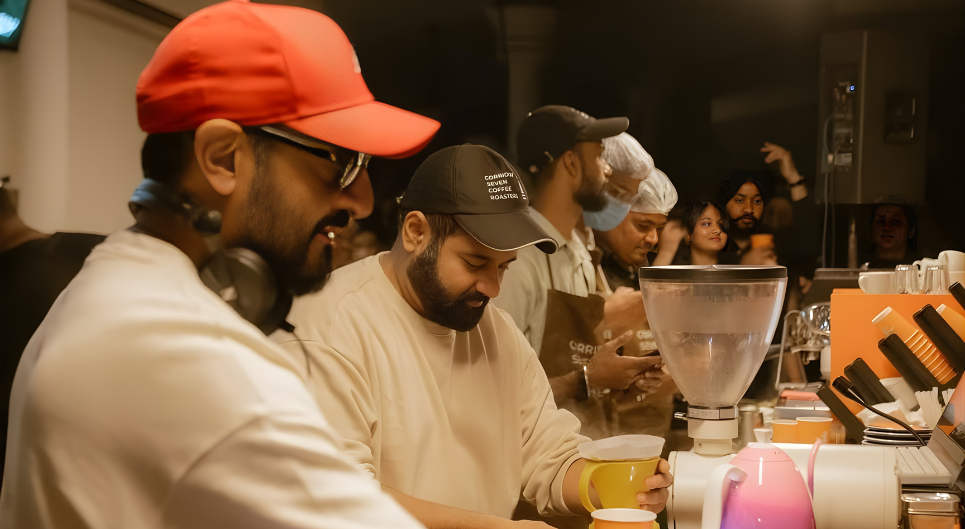
    A coffee rave underway at Corridor Seven Coffee Roasters in Nagpur | Image Credit: Mithilesh Vazalwar on Instagram


    India’s version looks different, and that difference is the story. For much of the past decade, alcohol in India’s major cities also functioned as a social shortcut, but under different conditions. Drinking was not just about taste or leisure. It was about urban fluency. To drink was to signal modernity and belonging in spaces that were already classed, gendered, and regulated.


    Now, across metros and increasingly in tier-2 cities, young professionals are opting out of alcohol situationally rather than ideologically. They are skipping rounds without apology, leaving earlier than expected, or choosing daytime socialising altogether. This is not prohibition, and it is not a backlash. It is conditional participation. Alcohol is no longer an automatic assumption for a social hang.


    Globally, sober curiosity emerged as backlash. In India, it looks more like recalibration. Less about excess. More about time, cost, and permission.


    Globally, this behaviour fits under the banner of sober curiosity. In India, it arrives with complications. Unlike Western markets, where sobriety often signals restraint from abundance, India’s relationship with alcohol has always been uneven. Large sections of the population abstain for religious, cultural, or economic reasons. What is new is not sobriety itself, but who gets to frame it as intention rather than constraint.


    In English-speaking, urban spaces, not drinking is slowly becoming legible as a choice. That shift is visible in the market. India’s non-alcoholic and zero-proof beverage industry, valued at roughly ₹1.37 lakh crore in 2023, is projected to cross ₹2.10 lakh crore by the end of the decade. Bars in Mumbai and Delhi now offer zero-proof cocktails priced like their alcoholic counterparts, complete with garnish, glassware, and ceremony. The point is not abstinence. It is equivalence. You can opt out without opting out socially.


    But the more revealing shift is not happening in bars. Across cities like Pune, Indore, Nagpur, and parts of Mumbai, early-morning “coffee raves” are drawing crowds that once would have gathered at nightclubs. Loud music, packed dance floors, caffeine instead of alcohol, and an exit time before noon. Similar sober daytime parties exist in New York or London, but in India their appeal is structural. They replace nightlife rather than supplement it. They fit around long workdays, shared housing, family expectations, and cost.


    This is where India diverges sharply from Western sober-curious narratives. The appeal is not only wellness or mindfulness. It is also efficiency. Alcohol costs time. Hangovers interfere with already compressed schedules. Late nights disrupt routines in cities where commutes are long, private space is scarce, and burnout is ordinary. In this context, sobriety reads less as self-denial and more as control. Not drinking is not about virtue. It is about being functional.


    A bottle of Pomegranate Kombucha | Image Credit: Shannon Nickerson on Unsplash


    Still, this permission is uneven. Choosing not to drink is celebrated when it appears intentional and curated. It is far less visible when abstention is expected or imposed. Women in India have long navigated sobriety without praise. Working-class abstention has rarely been framed as lifestyle. The current moment becomes visible largely because a certain class can afford to turn moderation into identity.


    That tension is what makes India’s sober curiosity worth paying attention to. This is not a wholesale rejection of drinking culture. Alcohol remains central to many social scenes. What is changing is the default. Refusal no longer requires justification everywhere. Social life is slowly learning to accommodate absence.


    Globally, sober curiosity emerged as backlash. In India, it looks more like recalibration. Less about excess. More about time, cost, and permission. This shift, uneven and easy to overstate, still marks something real. It reflects a change in how people gather, celebrate, and belong. In a culture where participation has long demanded conformity, opting out without disappearing is a meaningful shift.